iSideWith political quiz
Compare with 12 axes: issue weights and political match percentages.
Read the guide →English guideVisit the test site ↗ — Independent test · opens in a new tabIndependent test · opens in a new tab

About 10–15 minutes
Statement 01 / 60
0%Economy
Discover where you stand. One statement at a time.
COMPARE THE FRAMEWORKS
Explore what each test measures before comparing your results.
UNDERSTAND THE TEST
12 axes is a free political values test that explores how you think about twelve areas of public life. Instead of placing every opinion on a single left–right line, 12 axes presents separate scales for the economy, personal freedom, democracy, social change and other questions. You can favour public healthcare, local decision-making and international cooperation at the same time. The result gives you a way to examine those combinations.
This website, 12axes.org, makes that exploration available in English, Simplified Chinese, Japanese, Portuguese, Korean, French, German, Spanish and Italian. Start answering directly above, choose a short or full questionnaire, and move at your own pace. There is no account, subscription or payment step. The purpose of 12 axes is to support reflection and discussion, not to assign your identity or tell you how to vote.
The test and standard results remain free. A personalized 30-page PDF costs US$4.99 once, with no subscription. It covers this answer set, test length and language.

Each scale describes a tension between two priorities. Equality and markets, for example, concern redistribution and economic incentives; liberty and authority concern personal freedoms and powers used to maintain order. Your position on one scale does not automatically determine your position on another. The twelve categories in 12 axes are editorial choices, not a claim that political beliefs have exactly twelve scientifically independent components.
Read the labels together with their definitions. In 12 axes, a preference for one side does not imply rejecting every idea associated with the other. Context, competing goals and uncertainty can all shape an answer. The statements ask about policy priorities rather than party membership, nationality or personal worth.
The quick version has 60 statements, five per dimension, and takes roughly 10–15 minutes. The full version has 288 statements, twenty-four per dimension, and takes roughly 45–60 minutes. These are reading-time estimates, not a timer. The 60 statements are a fixed subset of the larger 12 axes bank, so both versions use the same definitions and answer scale.
Choose quick mode for an introduction or full mode to consider a broader range of situations. Longer does not mean scientifically more accurate. Each 12 axes questionnaire keeps separate progress in this tab, so switching between them does not replace your answers. Switching language keeps your place and your selections.

Choose strongly agree, agree, neutral or unsure, disagree, or strongly disagree for each statement. Answer the statement as written, even if its trade-off feels difficult. You can go back and change a response before finishing. Keyboard users can choose with 1–5 and continue with Enter. The 12 axes test has no right answers and does not reward a particular political outlook.
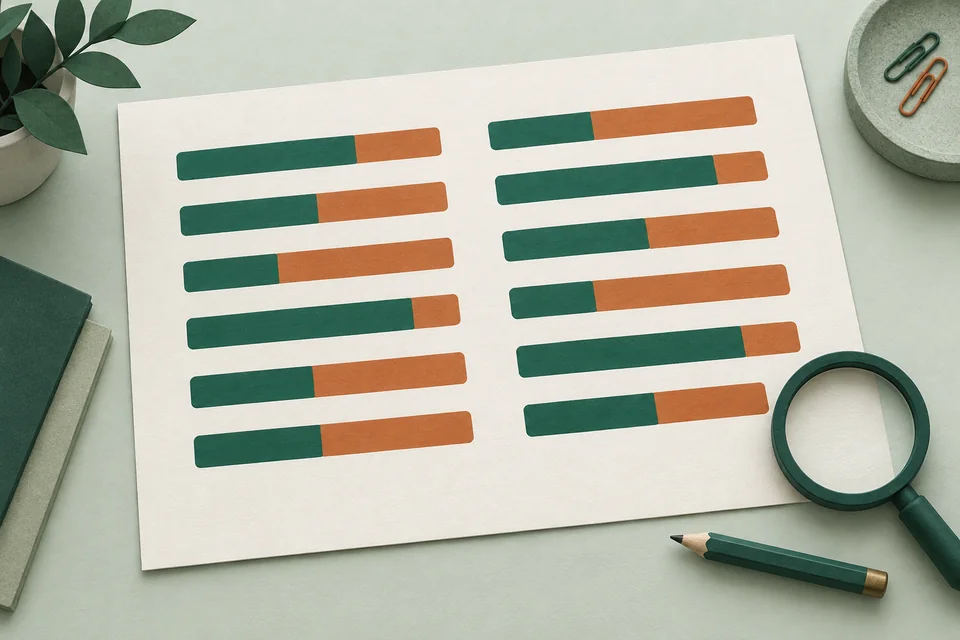
When you finish, 12 axes shows twelve pairs of percentages and the number of neutral answers on each scale. A 70/30 result describes your position on that questionnaire; it does not mean that 70% of people agree with you. A midpoint can reflect uncertainty or strong opinions that balance out. The methodology page explains the calculation, including how both directions receive equal total weight.
12 axes calculates scores in your browser. Answers and progress stay in this tab’s session storage, rather than an application account. This application does not send your answers or scores as analytics events, or place them in shareable URLs. Google Analytics is included to measure website usage; its data practices are explained in the privacy and cookie pages.
12 axes is an independent self-reflection project. The questionnaire and translations have not undergone independent psychometric or cross-cultural validation. It is not a clinical assessment, public-opinion poll or voting recommendation. Use the result as a conversation starter, revisit the underlying statements, and allow your views to change. For wording corrections, accessibility problems or privacy questions, contact [email protected].
Each pair below has its own definition. Explore the complete dimension guide if you want more context before answering.
Equality / Markets
Redistribution and reducing economic inequality versus market incentives and private enterprise.
Social provision / Self-reliance
Public responsibility for basic needs versus individual and voluntary responsibility.
Liberty / Authority
Protection of personal freedoms versus wider powers for public order.
Participation / Leadership
Direct public involvement versus greater discretion for elected leaders.
Reform / Tradition
Revising inherited norms versus preserving established customs and institutions.
Internationalism / Sovereignty
Shared international decision-making versus national independence.
Diplomacy / Force
Negotiation and restraint versus military deterrence and intervention.
Openness / Restriction
Easier movement and settlement versus tighter entry and residence rules.
Ecology / Growth
Ecological protection versus prioritising economic expansion when the two conflict.
Secularism / Religious influence
Separation of religion and public authority versus a greater role for religious principles.
Precaution / Acceleration
Prior checks on emerging technologies versus faster experimentation and adoption.
Decentralisation / Centralisation
Local autonomy versus unified national decision-making.
It explores related questions, but uses twelve separate scales rather than a single two-dimensional chart. It does not reproduce or certify another test’s model.
The definitions and scoring approach are shared, but different statements can produce different results. Compare the pattern and your answers rather than treating a small percentage change as significant.
Yes. Progress is saved in the current tab when browser storage is available. Closing a tab usually clears it, though restored browser sessions may restore the data. No account-based backup is provided.
Download a result card as a PNG, use your device’s share menu when available, or print a PDF. The card includes your scores. The invitation link opens the questionnaire and contains no personal result.